How Much Does It Cost to Grade a Pokemon Card? (San Antonio Guide)

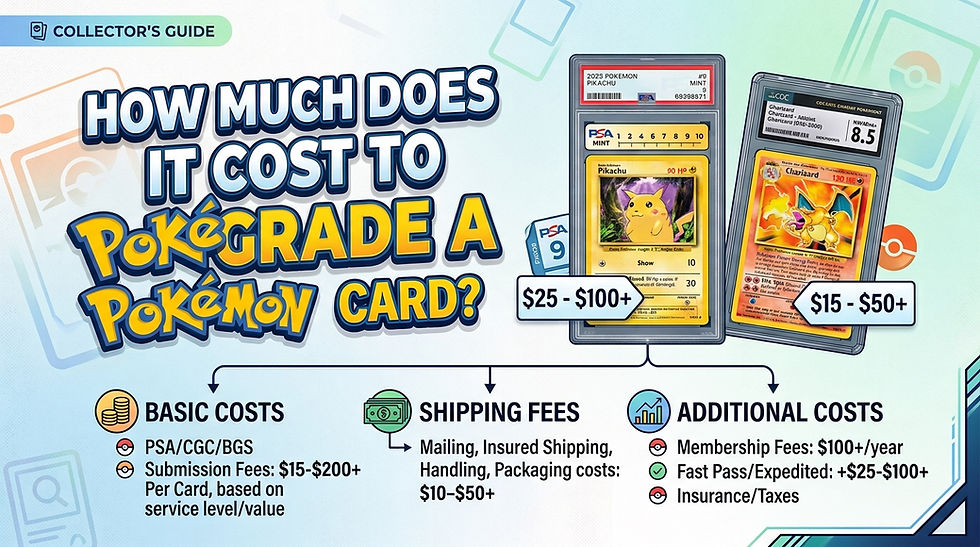
Quick answer: How Much Does It Cost to Grade a Pokemon Card? Budget tiers run as low as about $15 per card with CGC, but PSA's cheapest currently available tier is $79.99 per card, and rush or high-value service can climb to $150 to $600+ once turnaround speed, declared value, membership, and shipping are added in. Before you spend a cent on grading, San Antonio collectors can inspect raw cards in person and buy pre-checked English and Japanese product at Niazi Bodega, 5138 UTSA Blvd, Suite 108, near UTSA.
Grading fees have shifted a lot this year, so if you are deciding whether to slab a card or sell it raw, the numbers below will save you from an expensive mistake. Here is the full 2026 breakdown, the hidden costs most guides skip, and a simple "grade it or skip it" framework.
How Much Does It Cost to Grade a Pokemon Card in 2026?
The honest answer is that it depends on which company you use, how fast you want it back, and how valuable the card is. Pricing changed twice in the past year, so older guides quoting $10 to $25 flat are out of date.
Here is what actually matters for the cost:
Which grader you choose (PSA, CGC, or Beckett/BGS)
Service tier (bulk and economy are cheapest, express and walk-through cost the most)
Declared value of the card, which sets your tier and your insurance fee
How many cards you submit at once (bulk rates reward volume)
Shipping and insurance both ways
One big 2026 change to know: PSA paused its cheapest Value tiers in June 2026 due to a massive submission backlog, which means the current minimum PSA cost for most collectors is $79.99 per card at the Regular tier. PSA also raised prices on several service levels on February 10, 2026, the second increase in about six months. That is why CGC has become the go-to budget option this year. PreGradeCardsPokemon Pricing
What It Costs to Grade a Pokemon Card at PSA, CGC, and Beckett
Quick plain-English version before the full table:
CGC is the cheapest professional route right now, with CGC Economy around $15 per card and no membership required. PreGradeCards
PSA commands the highest resale premiums but costs the most to enter, with Regular at $79.99 as the effective floor today.
Beckett (BGS) sits in between and is popular with collectors who want its subgrades.
2026 Pokémon Card Grading Cost Breakdown by Company
Here is the side-by-side. Treat these as current-as-of-2026 reference points and always confirm live rates on each company's official site before you submit, since graders have been adjusting pricing frequently.
Grading Service | Base Cost Per Card | Turnaround Time | Declared Value Cap | Best Used For |
PSA (Regular tier) | $79.99 (current entry point) | ~25 business days | ~$1,499 | High-value vintage and chase cards where the PSA premium pays off |
CGC (Bulk / Economy) | ~$15 | Varies by tier | Varies by tier | Bulk modern cards, best budget option |
Beckett / BGS (Standard) | ~$20–$30 | Varies by tier | Varies by tier | Collectors who want BGS subgrades |
Express / Speed tiers | ~$150–$600+ | ~15 business days or faster | Higher caps | Urgent, high-value single cards |
A note on that PSA row: its old Value tiers ran from Value Bulk at $24.99 up through Value Max at $64.99, but all four are paused as of mid-2026, and the premium Walk-Through service runs $599 per card. So the "cheap PSA grading" many collectors remember is not available right now. Pokemon Pricing
Hidden Costs to Consider Before Grading
The sticker price per card is only part of the story. These extras are what actually determine whether grading is worth it.
Return shipping and insurance. You pay to ship cards there and back, insured. All-in ancillary costs typically run about $20 to $35 per CGC submission, $50 to $70 per BGS submission, and $100 to $120 per PSA submission once shipping and fees are included. Budget $15 to $50 for the round trip depending on batch size and value. PreGradeCards
Declared value surcharges. PSA adds a 2% insurance surcharge on declared value above $499. If your card grades higher than expected and its market value jumps, your fees can rise too. Pokemon Pricing
Membership fees. PSA's lowest bulk rates require a Collectors Club membership at $149 or $199 per year. CGC does not require membership for its bulk rate, which is part of why it undercuts PSA. Pokemon Pricing
Protective gear. Card savers, penny sleeves, a microfiber cloth for dust, and submission supplies all add a few dollars per batch. Small, but it adds up on large submissions.
Add it all together and a single PSA card often costs closer to $100 all-in than the $79.99 headline. That reality is exactly why the next section matters.
Is It Worth Grading Your Pokémon Cards?
Grading only makes sense when the grade adds more value than the total cost. Here is a simple decision matrix.
Grade it if:
The raw card is worth roughly $40 to $50 or more
You realistically expect a 9 or 10 grade (clean surface, sharp corners, good centering)
It is a vintage holo, a Charizard, or a rare chase card where even mid grades carry a premium
Authentication alone lifts the price, which is common for older and high-end cards
Skip grading if:
The card has visible surface scratches or print lines (often an automatic 9 or lower on modern cards)
There is whitening on the corners or edges (this frequently caps the grade)
The raw market value is under about $15 to $50, since fees will eat any profit
The rule of thumb collectors use in 2026: if a card's raw value is below about $50, grading at current prices will usually cost more than the grade adds, with exceptions for vintage cards and extreme Pokémon chase cards. A quick way to sanity-check: your expected graded value at the most likely grade should be at least double your total cost.
Pre-Inspect Your Raw Cards in San Antonio First
Here is where a local shop saves you money. The single biggest waste in grading is submitting a card that comes back an 8 because of a flaw you did not catch. Inspecting your cards closely before you spend $80 to $120 per submission is the smartest free step you can take.
Niazi Bodega on UTSA Blvd is a convenient spot for San Antonio collectors to buy sealed English and Japanese product and look over raw cards in good light before deciding what is worth sending to PSA or CGC. We are minutes from the UTSA campus and an easy drive from the Medical Center, Leon Valley, and Helotes. For the full local buying rundown, our San Antonio Pokémon Card Buyer's Guide is the best place to start.
While you are stocking up, our customers often browse other pop-culture finds too, from Pop Mart Labubu figures to viral exotic snacks and drinks for the road.
Stop By or DM Before You Grade
Thinking about grading a card and want a second set of eyes on it first? Come see us at Niazi Bodega, 5138 UTSA Blvd, Suite 108, San Antonio, TX 78249, just minutes from UTSA, to browse English and Japanese Pokémon booster packs and look over your raw cards before you submit to PSA or CGC. Questions about what is in stock or worth pulling? DM @niazibodega on Instagram and we will help you out.