What Is the Most Expensive Pokemon Card? (Updated November 2026)


The most expensive Pokemon card ever sold is a PSA 10 Pikachu Illustrator. Logan Paul's copy sold at Goldin Auctions on February 16, 2026 for $16,492,000, a Guinness World Record for any trading card sold at auction.
But it's not the only seven-figure card anymore. 2026 pushed four more Pokemon cards near or past $1 million. Below is the full top 10, why these cards are so pricey, and a quick checklist to see if anything in your binder is worth a closer look.
The Most Expensive Pokemon Card: Pikachu Illustrator ($16.49M)
The Pikachu Illustrator is the rarest and most valuable Pokemon card in the world. It was given to winners of a 1998 CoroCoro Comic art contest in Japan, with only 41 copies known. The single PSA 10 copy sold for $16,492,000 in February 2026, more than triple the $5.275 million Logan Paul paid for it in 2021.
A few things make this card untouchable:
Tiny supply. Only 41 copies are known, and PSA has graded about 20 of them.
Only one perfect copy. Logan Paul's card is the only known PSA 10 (Gem Mint).
The art. It was drawn by Atsuko Nishida, credited as Pikachu's original creator.
It says "Illustrator," not "Trainer." That text at the top is unique to this card.
The buyer was venture capitalist AJ Scaramucci. The final price includes Goldin's 22% buyer's premium and came after 97 bids over roughly six weeks. It also beat the previous all-time trading card record, a $12.93 million basketball card, by more than $3.5 million.

Top 10 Most Expensive Pokemon Cards Ever Sold (2026 Ranking)
These are the 10 most expensive Pokemon cards, ranked by each card's highest verified public sale. We list each card once, so one Pikachu Illustrator doesn't take up five spots. Prices include buyer's premium where the auction house reported it.
Rank | Card | Grade | Price | Sold | Where |
1 | Pikachu Illustrator (1998 Japanese promo) | PSA 10 | $16,492,000 | Feb 2026 | Goldin |
2 | Bronze 3rd Place Trophy Pikachu (1998 Japanese) | PSA 10 | $1,769,000 | May 2026 | Goldin |
3 | Charizard, 1996 Japanese Base Set, No Rarity Symbol | PSA 10 | $1,700,000 | Mar 2026 | Reported private sale |
4 | Charizard, 1999 1st Edition Base Set (Shadowless) | PSA 10 | $1,000,953 | Sep 2026 | eBay |
5 | 1st Tournament Trophy Pikachu | PSA 8 | $982,100 | Mar 2026 | Goldin |
6 | Charizard, Topsun Blue Back (1995 Japanese) | PSA 10 | $493,230 | Jan 2021 | Goldin |
7 | Silver No. 2 Trainer Trophy Pikachu (1997-98) | PSA 10 | $444,000 | Sep 2023 | Goldin |
8 | Lugia, Call of Legends #15 (2011) | PSA 10 | $367,220 | Sep 2026 | Goldin |
9 | Blastoise, Commissioned Presentation Holo | CGC 8.5 | $360,000 | Jan 2021 | Heritage |
10 | Gengar, Japanese Vending Promo #94 (1999) | PSA 10 | $207,000 | Sep 2026 | eBay |
Notice the pattern: six of the ten are Pikachu or Charizard, and half of them set their record in 2026. Prices change fast, so treat this as a snapshot, not a price guide.
2. Bronze 3rd Place Trophy Pikachu ($1.77M)
Trophy cards were handed to top finishers at early Japanese tournaments, never sold in packs. This PSA 10 Bronze copy sold for $1.769 million in May 2026. It was already past $1 million with three weeks of bidding left.
3. 1996 Japanese No Rarity Symbol Charizard ($1.7M)
The very first print run of Japanese Base Set cards has no rarity symbol in the bottom-right corner. A PSA 10 Charizard from that run became the first Charizard ever to break $1 million in March 2026. Five days later, another copy in a case signed by artist Mitsuhiro Arita sold for $1,232,200 at Goldin.
4. 1st Edition Base Set Charizard ($1M)
This is the card most collectors grew up chasing in the U.S. It held a $420,000 record from 2022 until December 2025, when a PSA 10 sold for $550,000 at Heritage. Then it doubled: a Logan Paul pack-break copy hit $954,800 in February 2026, and an eBay sale crossed $1,000,952 in September.
5-10. The rest of the list
1st Tournament Trophy Pikachu: proof that even a PSA 8 can bring nearly $1 million when the card is rare enough.
Topsun Blue Back Charizard: a 1995 Japanese candy-promo card. It was the priciest Charizard at auction until the 1st Edition passed it in late 2025.
Silver No. 2 Trainer Pikachu: the second-place trophy from the first official tournament in 1997.
Lugia, Call of Legends: the newest card on the list, from 2011. Modern cards can make the cut when PSA 10 copies are scarce.
Blastoise Presentation Holo: a pre-production card made to pitch the English release. Graded only 8.5 and still worth $360,000.
Gengar Vending Promo: a 1999 Japanese vending-machine card that sold for $207,000 in September 2026.
Why Are Some Pokemon Cards Worth So Much?
A Pokemon card's price comes down to four things: how many exist, what condition it's in, which Pokemon is on it, and its story. A rare card in perfect condition with Pikachu or Charizard on it, plus a famous past owner, can sell for millions.
Factor | What it means | Example from the list |
Scarcity | Prize, trophy, or first-print cards with tiny print runs | 41 known Pikachu Illustrators |
Condition (grade) | A PSA 10 can be worth many times a PSA 9 | Illustrator: $16.49M at PSA 10 vs $1.41M at PSA 9 |
Character | Pikachu and Charizard dominate demand | 6 of the top 10 |
Provenance | Who owned it, where it was pulled | Logan Paul break Charizard: $954,800 |
First print | Earliest versions beat reprints | 1st Edition and No Rarity Symbol cards |
How Much Does Grading Change a Card's Price?
Grading is the single biggest price lever you control. The same card can be worth 10 to 60 times more at PSA 10 than at a mid grade. The catch: only a small share of submitted cards earn a 10. Of about 5,300 1st Edition Charizards graded by PSA, only about 124 are PSA 10.
Same card, different grade | Grade | Sale price | Sold |
Pikachu Illustrator | PSA 10 | $16,492,000 | Feb 2026 |
Pikachu Illustrator | PSA 9 | $1,406,250 | Mar 2026 |
Pikachu Illustrator | PSA 7 | $900,000 | Feb 2022 |
1st Edition Charizard | PSA 10 | $1,000,953 | Sep 2026 |
1st Edition Charizard | BGS 8 | $14,000-$16,000 | Jan 2026 |
Takeaway: don't sell a vintage holo raw until someone has looked at it under good light. A small whitening spot or off-center print can be a five-figure difference.

Could You Have a Valuable Pokemon Card? A 60-Second Check
You almost certainly don't have a Pikachu Illustrator, but plenty of 1999-2003 cards are worth hundreds or thousands. Pull out any old holos and run through these checks. If a card hits two or more, it's worth having someone look at it in person.
Look for the 1st Edition stamp. A small black "Edition 1" circle sits just below the bottom-left corner of the artwork.
Check for "shadowless." On early Base Set cards, the art box has no drop shadow on its right side.
On Japanese cards, check the bottom-right corner. No rarity symbol at all on a 1996 Base Set holo is a big deal.
Read the top of the card. "Illustrator" instead of "Trainer," or a trophy design, means it's a contest or tournament card.
Look for promo or trophy markings. Stamps, odd numbering, or non-standard backs (like Topsun's blue back) can signal rarity.
Check condition honestly. Look at corners, edges, surface scratches, and centering under a bright light.
What to Do If You Think You Have a Rare Card
Protect it first, then get an expert opinion before you grade or sell. Handling a card raw can drop its grade in seconds. A local shop can tell you in a few minutes whether grading is worth the fee or whether you're better off selling it as-is.
Sleeve it now. Put it in a soft penny sleeve, then a top loader. Don't use rubber bands or binders with tight pockets.
Don't clean it. Wiping or pressing a card can cause scratches that cost a grade.
Look up recent sold prices. Use sold listings, not asking prices. PriceCharting and eBay sold filters are good starting points.
Get a second set of eyes. Show it to an experienced collector or a grading service before you decide anything.
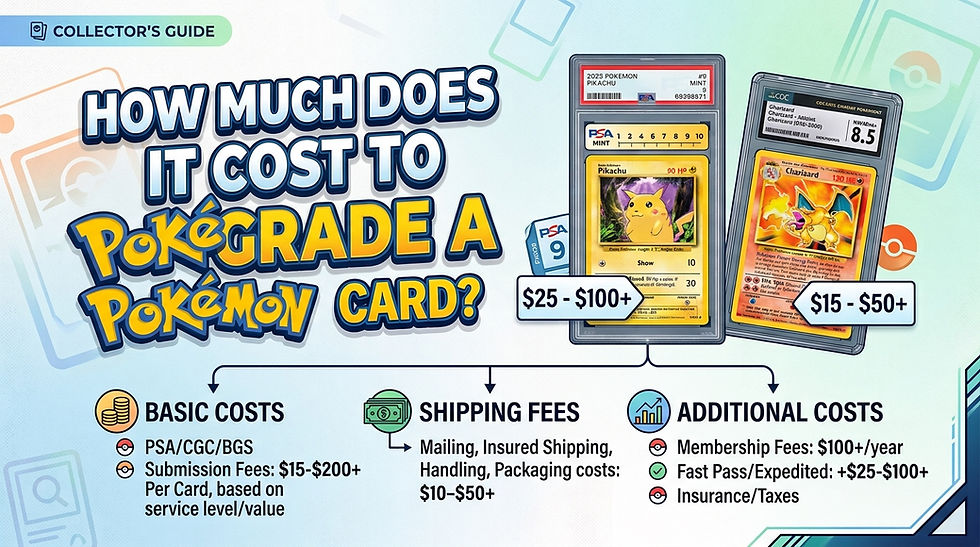
Decide on grading. For most cards under $50 raw, grading costs more than it adds. For vintage holos in great shape, it usually pays.
Sell where buyers are. High-end cards go to auction houses like Goldin or Heritage. Everyday cards sell well locally, where you skip shipping and fees.
Frequently Asked Questions
Is the Pikachu Illustrator still the most expensive Pokemon card in 2026?
Yes. The PSA 10 copy's $16,492,000 sale on February 16, 2026 is the record for any Pokemon card and any trading card sold at auction. The next highest Pokemon sale this year was a Bronze Trophy Pikachu at $1.769 million.
What is the most expensive Charizard card?
A PSA 10 1996 Japanese Base Set Charizard with no rarity symbol, which sold for a reported $1.7 million in March 2026. The most expensive English Charizard is the 1st Edition Base Set PSA 10, which topped $1 million on eBay in September 2026.
How much is a regular Pikachu Illustrator worth?
There's no "regular" one, since only 41 exist. Lower-grade copies still sell for six or seven figures: a PSA 9 brought $1,406,250 in March 2026, and a PSA 7 sold for $900,000 in 2022.
Are new Pokemon cards ever worth this much?
Rarely, but it happens. A 2011 Lugia from Call of Legends sold for $367,220 in 2026. Modern cards hit big numbers when PSA 10 copies are scarce, but most current pulls are worth far less.
Where can I buy Pokemon cards in San Antonio?
Niazi Bodega at 5138 UTSA Boulevard, Suite 108, near the UTSA campus, carries Pokemon cards alongside other collectibles. Call (210) 463-9082 or visit niazibodega.com to check what's in stock.
Hunting for your own chase card? Stop by Niazi Bodega at 5138 UTSA Boulevard, Suite 108, San Antonio, TX 78249. Call us at (210) 463-9082 or visit niazibodega.com.